Cannabis Nutrients by Stage: A Feeding Schedule from Clone to Harvest
What the plant needs in veg, flower and the final week, how to read a feeding chart, and the signals that tell you to adjust.
Cannabis needs the same mineral nutrients from clone to harvest, but in changing proportions: more nitrogen while it builds leaves and stems in veg, more phosphorus, potassium and sulfur once it flowers, and calcium the whole way through. A feeding schedule sets which products to run at each stage and how strong to mix them.
What nutrients does cannabis need at each stage?
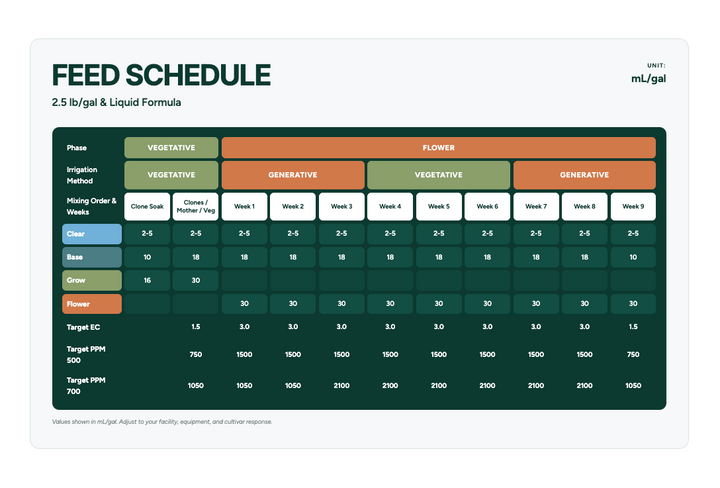
| Stage | What the plant is doing | HGV program | Schedule target EC |
|---|---|---|---|
| Clones, mothers and veg | Rooting, then building canopy | Base + Grow | 1.5 |
| Flower | Stretch, flower set and bulking | Base + Flower | 3.0 |
| Final week | Ripening | Base + Flower | 1.5 |
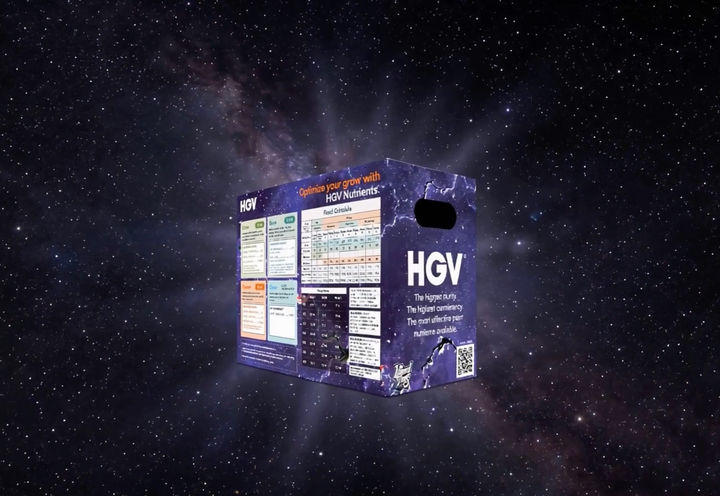
The targets above come from HGV's published feed schedule, which lists week-by-week rates along with the matching PPM values. Every room is different, so treat the schedule as a starting point and adjust to your facility, equipment and cultivar response.
How do you feed in veg?
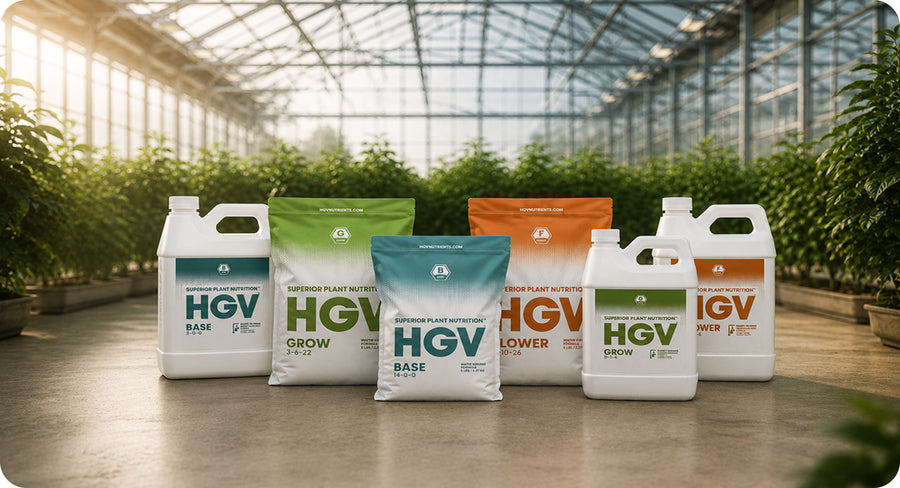
Vegetative plants are building the frame that will carry the flowers. Nitrogen drives that growth, with potassium and calcium supporting cell expansion and structure. In the HGV program, Base supplies calcium and nitrogen and Grow (3-6-22) supplies the rest. Clones and young plants take a lighter feed than established ones.
How do you feed in flower?
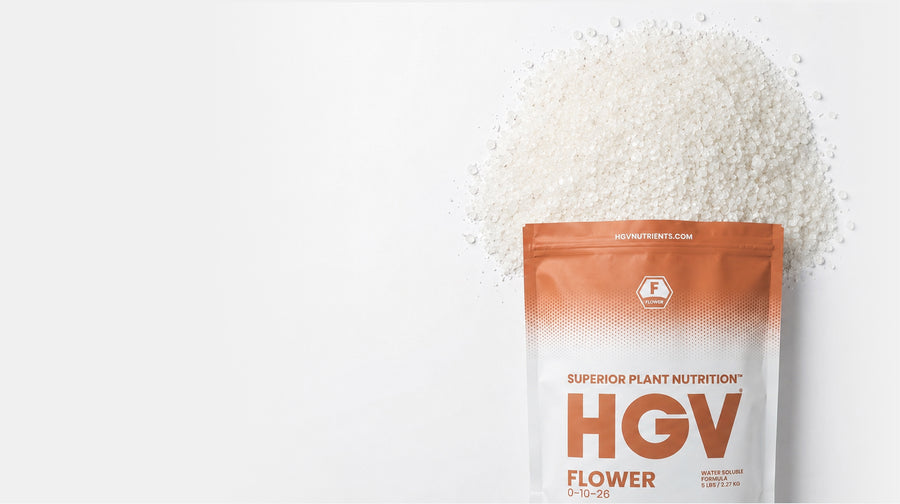
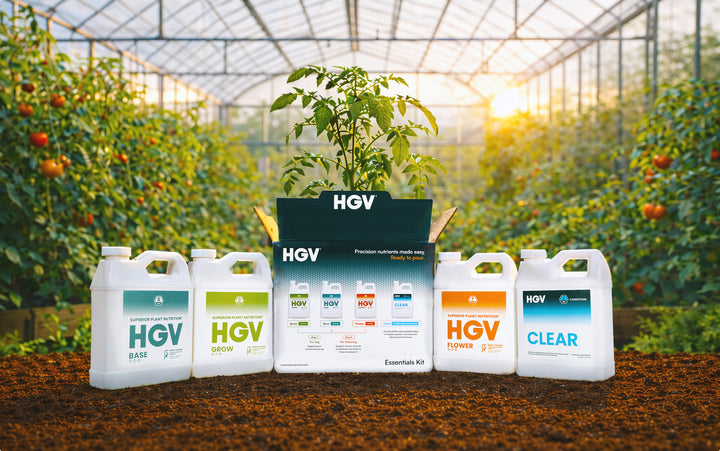
At the start of flower, Grow comes out and Flower (0-10-26) goes in. Base stays. The schedule holds an EC of 3.0 through flower, which with the Liquid line or a 2.5 lb per gallon concentrate is 18 mL of Base and 30 mL of Flower per gallon. The article on bloom nutrients explains why the ratio shifts and whether boosters are worth it.
How do you read a feeding chart?
- Columns are time. Each column is a growth stage or a week of flower.
- Rows are products. The number in each cell is the dose, in milliliters or grams per gallon of water.
- EC and PPM rows are your check. After mixing, your meter should land on the target. PPM is listed on both the 500 and 700 scales because meters differ. See EC and PPM explained.
- The order of rows is the mixing order. Products are added top to bottom.
How do you know if the plants want more or less?
A chart cannot see your room. These are the signals worth checking before you change a dose:
- Runoff EC climbing well above input EC: salts are accumulating. Increase runoff volume or ease the feed.
- Runoff EC well below input: the plants are eating more than they are given.
- Dark, clawed leaves: often blamed on nitrogen, but frequently a calcium deficiency, potassium excess or simple overwatering. A tissue test is the reliable way to confirm.
- pH out of range: fix this first. A correct feed at the wrong pH behaves like a deficient one.
When symptoms do not match the numbers, plant and water testing replaces guesswork with a lab report. The guide to nutrient deficiencies covers what each symptom pattern usually means.
Does the medium change the schedule?
The products and ratios stay the same in coco, rockwool, peat mixes and water culture. What changes is irrigation: how often you feed and how much runoff you take. HGV's guidance is that starting at EC 3.0 is generally a safe approach across media and light types, then adjusting for pot size, environment and genetics. Soil is the exception. Soil holds its own nutrient reserve, so get a soil test before applying a full-strength program.
What should you not add?
A complete base program does not need a shelf of supplements. HGV supplies enough calcium and magnesium that cal-mag is not required, and biostimulants such as kelp and humic acids are not necessary in rockwool or coco. If you want to trial an additive, run it side by side against a control and keep it only if you can measure the difference.
Comparing programs? See the best cannabis nutrients of 2026.
Frequently asked questions
What are the best nutrients for cannabis?
A complete, fully soluble mineral program with separate grow and bloom ratios and calcium supplied throughout. Consistency from batch to batch and published rates matter as much as the formula, because they are what let you repeat a good run.
How often should you feed cannabis?
In soilless media such as coco and rockwool, plants are fed with nutrient solution at every irrigation, often several small irrigations a day in flower. Frequency depends on pot size, medium and environment.
Is the feeding schedule different for LED and HPS?
HGV does not publish separate charts by light type. Start at EC 3.0, monitor the crop and adjust for your environment, medium and genetics.
Will nutrients change how long cannabis takes to finish?
No. Maturation time in healthy plants is determined by genetics. Stressed plants may finish early, but proper nutrition does not shorten or extend the natural timeline.
Can I use HGV with mycorrhizae or root inoculants?
Yes. Products that promote a healthy root system can be used alongside HGV nutrients.