Dry vs Liquid Nutrients: Cost, Convenience and What Actually Changes
They can be chemically identical. Here is how they differ on cost per gallon, labor and storage, and how far each package really goes.
Dry and liquid nutrients can deliver exactly the same nutrition. A liquid nutrient is a dry mineral salt that has already been dissolved in water. Dry costs less per gallon of finished feed and is cheaper to ship and store. Liquid skips the step of making a concentrate. The right choice comes down to scale, labor and how much you value convenience.
What is the actual difference between dry and liquid nutrients?
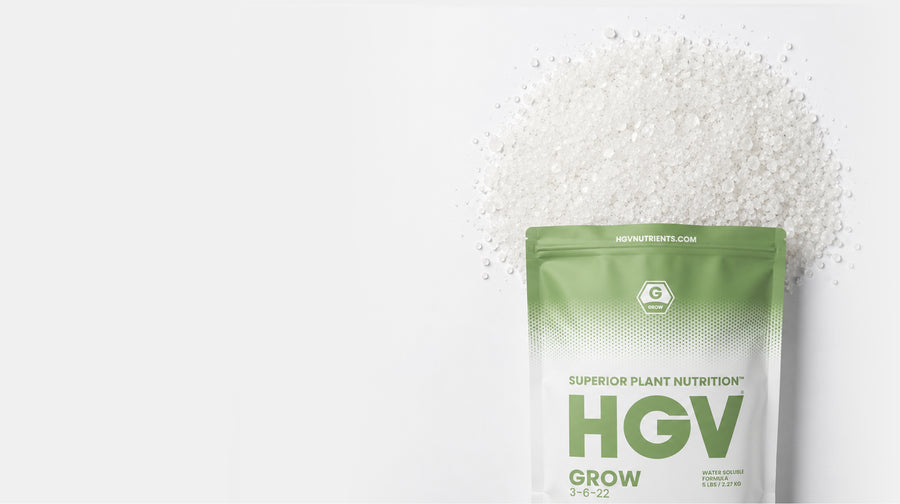
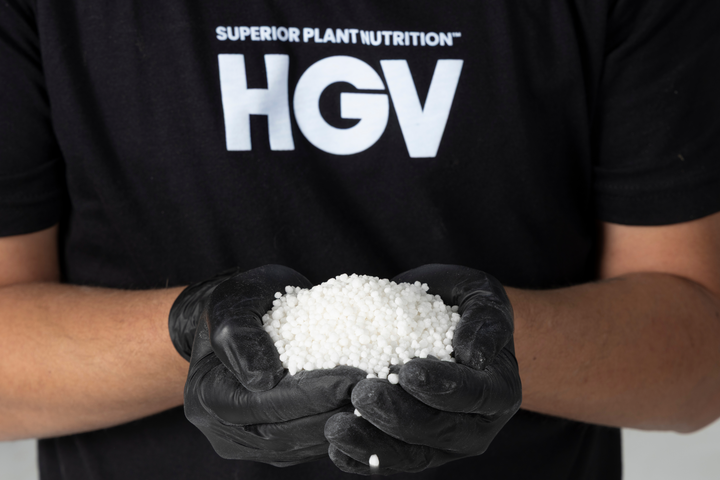
Water. Dry nutrients, also called water-soluble fertilizers, powdered nutrients or nutrient salts, are the minerals themselves. Liquid nutrients are those minerals in solution. Once either one is diluted into a reservoir, the plant cannot tell them apart.
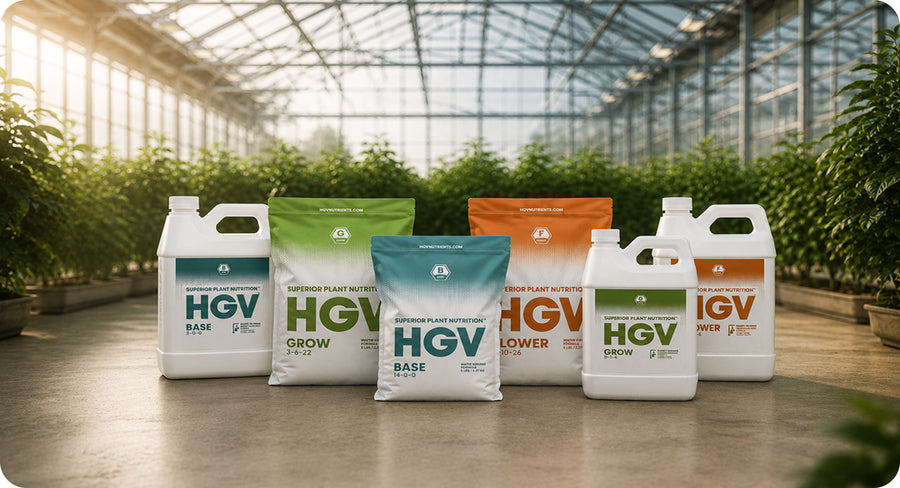
Some liquid lines split their elements across many bottles, which makes them harder to compare. HGV keeps it direct: HGV Liquid is the bagged HGV Dry formula dissolved at the standard 2.5 lb per gallon. Same formula, same usage rates.
How do dry and liquid compare?
| Dry | Liquid | |
|---|---|---|
| Cost per gallon of feed | Lowest | Higher, because you pay to ship and bottle water |
| Prep before use | Dissolve into a concentrate, or weigh into each batch | None. Measure and pour |
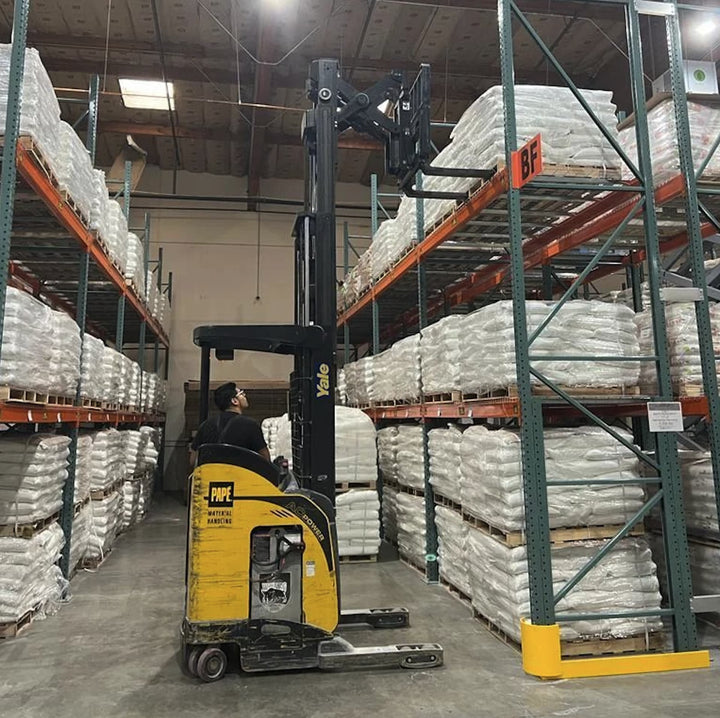
| Storage footprint | Small | Larger and heavier |
| Shelf life | No expiration when kept cool and dry | Months when stored clean and sealed |
| Measuring | By weight (grams) or by volume once concentrated | By volume (mL) |
| Best fit | Commercial rooms, injector systems, anyone feeding in volume | Smaller grows and anyone who wants zero mixing steps |
How far does a bag or jug go?
Using HGV's published rates at a target EC of 3.0:
| Package | Rate at EC 3.0 | Finished feed |
|---|---|---|
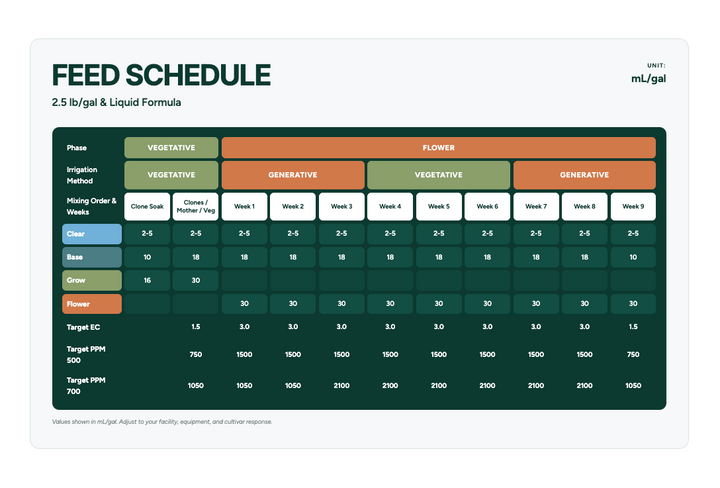
| Grow or Flower, 5 lb dry | 7.0 g per gallon | About 324 gallons |
| Base, 5 lb dry | 4.2 g per gallon | About 540 gallons |
| Grow or Flower, 25 lb dry | 7.0 g per gallon | About 1,620 gallons |
| Base, 25 lb dry | 4.2 g per gallon | About 2,700 gallons |
| Grow or Flower, 2.5 gallon liquid | 30 mL per gallon | About 315 gallons |
| Base, 2.5 gallon liquid | 18 mL per gallon | About 526 gallons |
Two things stand out. A 25 lb bag makes roughly five times the feed of a 2.5 gallon jug, and Base goes further than Grow or Flower because it is dosed at a lower rate. To compare cost, divide the price of each package by the gallons it makes, then add the Base figure to the Grow or Flower figure. The usage calculator will size a full run for you.
How do you use dry nutrients?
There are two ways, and both are simple.
- Weigh into each batch. For small reservoirs, weigh grams per gallon straight into the water. At EC 3.0 that is 4.2 g of Base and 7.0 g of Grow or Flower per gallon.
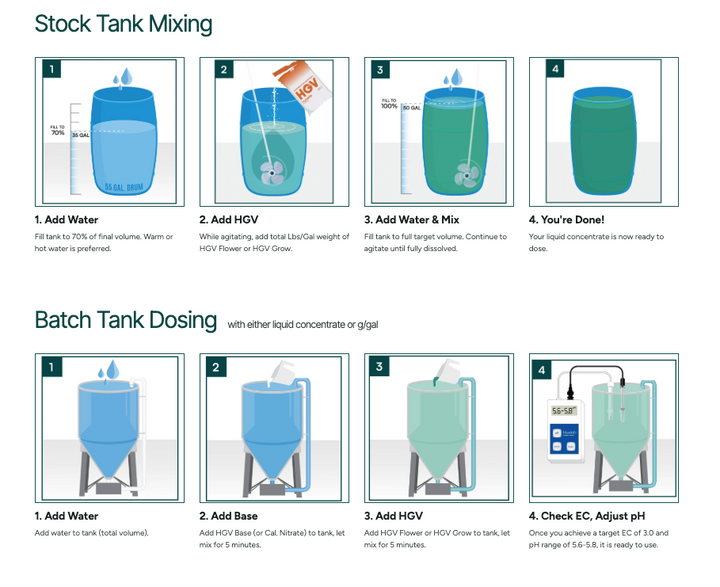
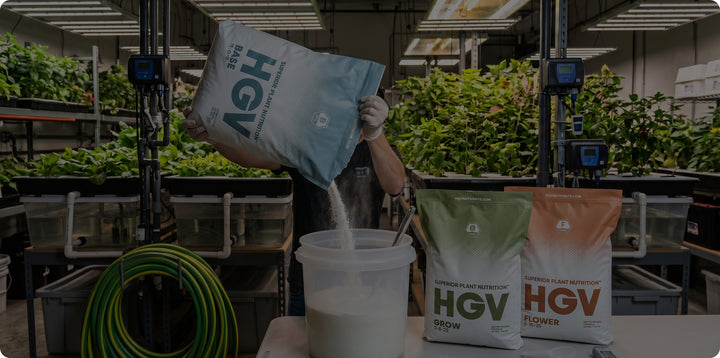
- Make a concentrate. Professional growers typically dissolve a full 25 lb bag in 10 gallons of water to make a 2.5 lb per gallon stock, one tank per product. From that point it is dosed like any liquid, by hand or through injectors.
Shake the bag before weighing out partial amounts. Particles settle by size in transit, and shaking redistributes them. Dissolving the entire bag at once avoids the issue completely. Step-by-step instructions are in how to mix a hydroponic nutrient solution.
Do dry nutrients go bad?
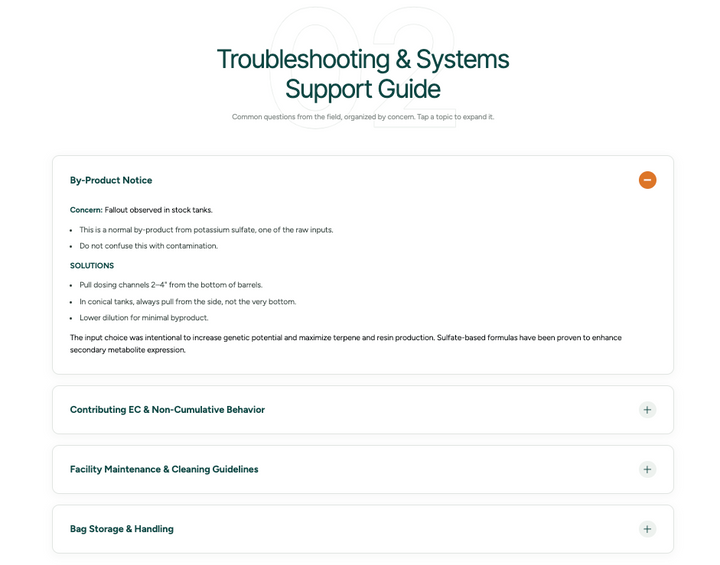
HGV dry fertilizers have no expiration date. They are hygroscopic, meaning they absorb moisture from the air, so a bag stored somewhere hot or humid can cake or clump. That is cosmetic. Caked product has the same composition and performs the same. The same goes for a blue or green tint, which comes from trace elements reacting with moisture. If a bag has clumped, break it up and dissolve the whole thing in hot water as a concentrate.
Which should you choose?
- Choose dry if you feed more than a few hundred gallons a month, run injectors or stock tanks, or want the lowest cost per gallon.
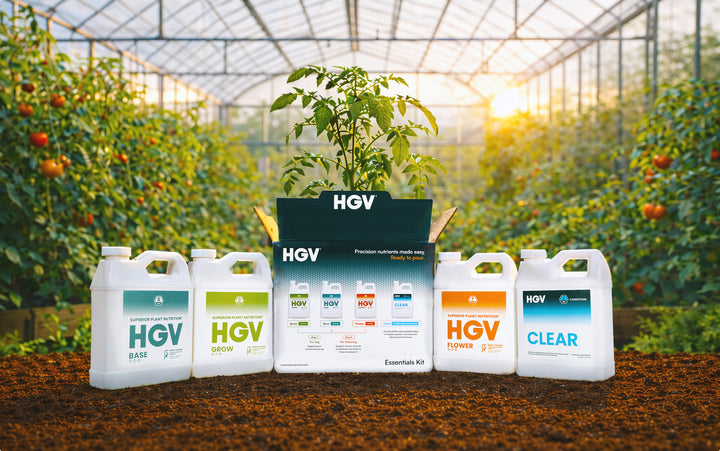
- Choose liquid if you run a small room, mix by hand, or would rather not make concentrates. The Essentials Kit is the simplest way to start.
- Switching later is painless. Because HGV Liquid matches a 2.5 lb per gallon dry concentrate, your milliliter rates do not change when you move from one to the other.
Choosing between dry lines? See the best dry nutrients compared.
Frequently asked questions
Are dry nutrients better than liquid?
Neither is better for the plant. Dry is more economical and compact. Liquid is more convenient. When the formula is the same, results are the same.
Are powdered hydroponic nutrients harder to use?
No. They need one extra step, dissolving, which takes a few minutes with warm water and agitation. After that a dry concentrate is used exactly like a bottled liquid.
Can I switch from liquid to dry in the middle of a run?
Yes. With HGV the liquid and the 2.5 lb per gallon dry concentrate share the same usage rates, so the feed the plant receives does not change.
Why did my dry nutrients clump?
Moisture. Dry water-soluble fertilizers absorb humidity over time. Clumped product is not defective and performs the same once dissolved. Store bags sealed in a cool, dry place to prevent it.
Do dry nutrients dissolve completely?
Quality water-soluble fertilizers dissolve fully when mixed within their solubility limits. Use warm water, agitate, and stay at or below 2.5 lb per gallon. Colder water holds less, so lower the concentration if you cannot use warm water.