Hydroponic Nutrients: What Plants Need and How to Choose a Line
What hydroponic nutrients are, which elements plants actually need, and how to choose a line you can run without a shelf of additives.
Hydroponic nutrients are water-soluble mineral fertilizers that supply every essential element a plant would otherwise pull from soil. A complete program delivers nitrogen, phosphorus, potassium, calcium, magnesium, sulfur and the micronutrients in a form roots can take up immediately, at a strength you control by EC and a pH you hold between roughly 5.5 and 6.5.
What are hydroponic nutrients?
In soil, minerals are released slowly by weathering and by microbes breaking down organic matter. In hydroponics, coco or rockwool there is no reserve to draw on. Everything the plant gets arrives dissolved in the irrigation water, which is why hydroponic fertilizers are built from fully soluble mineral salts and why the grower, not the medium, decides what the plant eats.
That control is the whole point. You can set the exact concentration of the feed, change the ratio between growth stages, and correct a problem in a single irrigation instead of waiting weeks for soil to respond.
Which elements do plants need?
Plants take carbon, hydrogen and oxygen from air and water. The remaining essential elements have to be supplied by the nutrient solution.
| Group | Elements | What they do |
|---|---|---|
| Primary macronutrients | Nitrogen (N), phosphorus (P), potassium (K) | Leaf and stem growth, energy transfer and root development, water regulation and flower development |
| Secondary macronutrients | Calcium (Ca), magnesium (Mg), sulfur (S) | Cell walls and new growth, chlorophyll, proteins and aromatic compounds |
| Micronutrients | Iron, manganese, zinc, copper, boron, molybdenum, chlorine, nickel | Enzyme systems, chlorophyll formation and hormone balance, needed in very small amounts |
A product is only "complete" if it covers all three rows. Many general garden fertilizers list N, P and K and assume the soil will provide the rest. In a soilless system that assumption fails, and the first symptoms usually show up as calcium, magnesium or iron problems.
Why do hydroponic nutrients come in two or three parts?
Calcium cannot share a concentrated container with phosphates or sulfates. At high concentration they react and fall out of solution as an insoluble solid, which means lost nutrition and clogged lines. Manufacturers solve this by putting calcium (usually with nitrogen) in one part and phosphorus, sulfur and most micronutrients in another. The parts only meet once they are diluted in the reservoir, where the reaction does not occur.
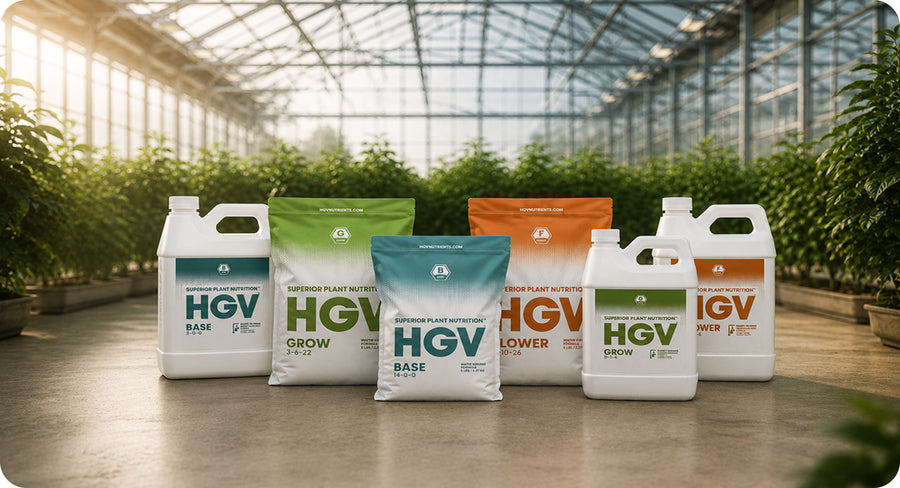
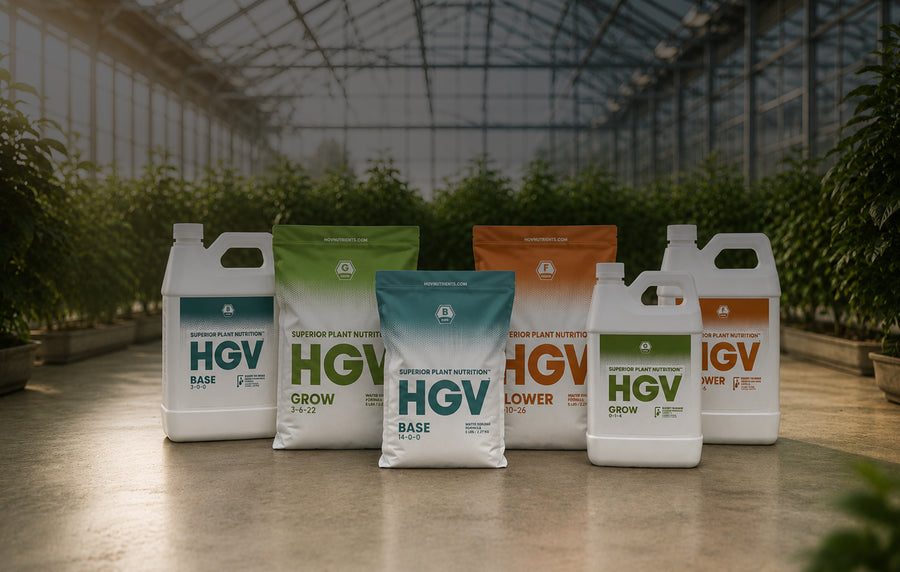
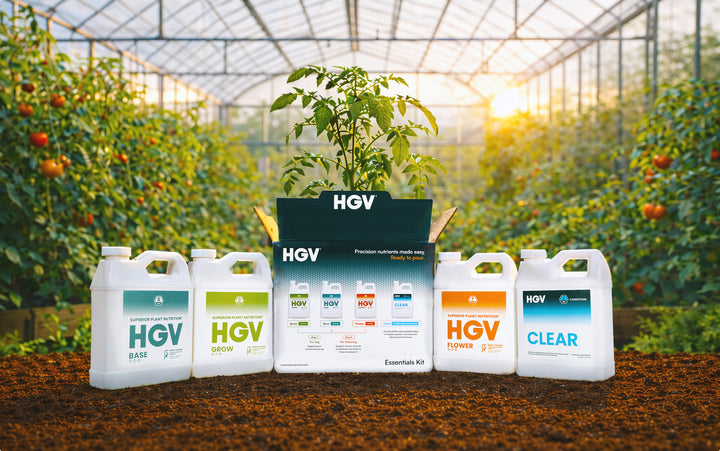
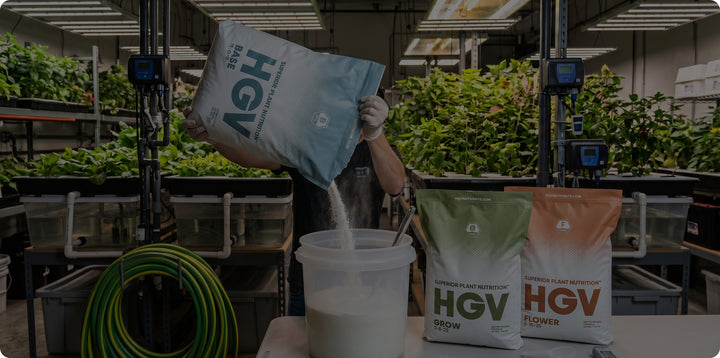
HGV follows this logic with a two-part program: Base carries calcium and nitrogen for the entire cycle, and you pair it with Grow in veg or Flower in bloom. For a closer look at the trade-offs, see two-part vs three-part nutrients.
Dry or liquid: which form should you buy?
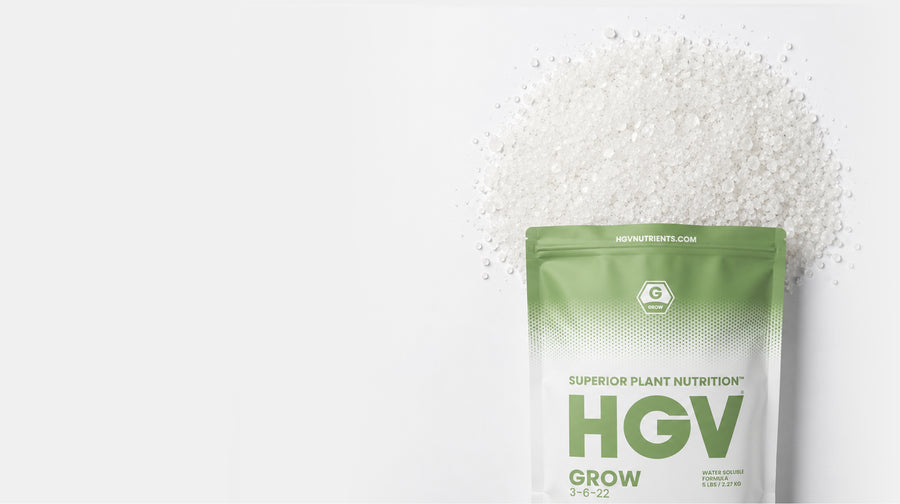
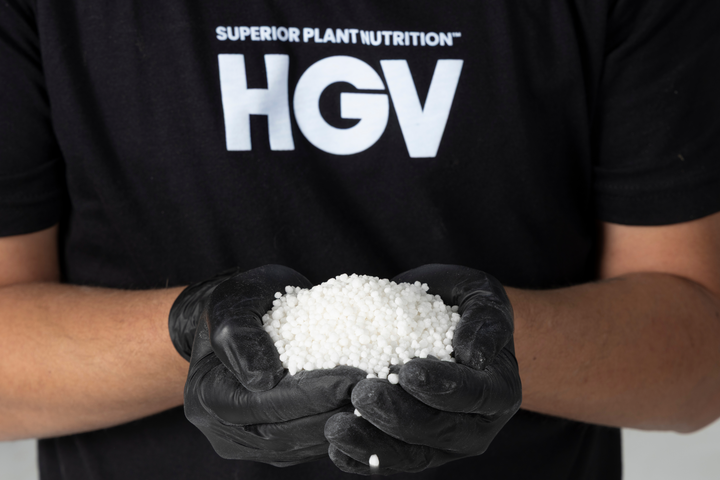
Dry and liquid hydroponic nutrients can be chemically identical. Liquid is simply the dry salt already dissolved in water. Dry costs less per gallon of feed and ships without the weight of water. Liquid saves the step of making a concentrate. HGV Liquid is the dry formula dissolved at 2.5 lb per gallon, so the usage rates are the same either way. The full comparison is in dry vs liquid nutrients.
How do you choose a hydroponic nutrient line?
- Is it complete on its own? Count the bottles the feed chart requires. A program that needs cal-mag, a booster and a finisher to perform is not complete, and each extra product is a chance for a mixing error.
- How many parts? Fewer parts means fewer measurements per batch and fewer stock tanks.
- What does a gallon of finished feed cost? Compare cost per gallon at your target EC, not cost per bag.
- Does it dissolve clean? Residue in a stock tank ends up in emitters.
- Is every batch the same? Ask whether the manufacturer blends in-house and tests each batch against spec.
- Are the rates published? You should be able to find grams or milliliters per gallon for a given EC without calling anyone.
For a side-by-side of the major lines, see the best hydroponic nutrients of 2026.
How much hydroponic nutrient do you use?
Strength is measured as electrical conductivity (EC). HGV publishes rates for each EC target. For the dry line, measured in grams per gallon of water:
| Target EC | Base | Grow or Flower |
|---|---|---|
| 1.0 | 1.4 g | 2.3 g |
| 1.5 | 2.1 g | 3.5 g |
| 2.0 | 2.8 g | 4.7 g |
| 2.5 | 3.5 g | 5.8 g |
| 3.0 | 4.2 g | 7.0 g |
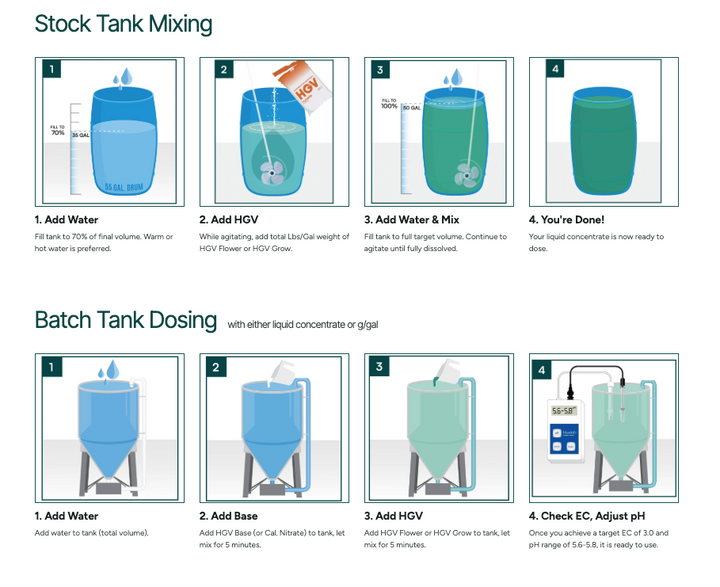
HGV mixes to a target EC of 3.0 and a pH of 5.6 to 5.8, measured after everything is dissolved. Rates for liquid and for stock concentrates are on the mixing and application guide, and EC and PPM explained covers how to choose a strength for your room.
Frequently asked questions
Can I use regular fertilizer for hydroponics?
Usually not. Garden fertilizers often rely on soil to supply calcium, magnesium and micronutrients, and some use nitrogen forms that need soil microbes to become available. A hydroponic nutrient has to be complete and fully water soluble.
Is hydroponic fertilizer the same as hydroponic nutrients?
Yes. The terms are used interchangeably, along with nutrient solution and plant food. All describe soluble mineral fertilizers formulated for soilless growing.
Do I need cal-mag with hydroponic nutrients?
Only if your base program does not supply enough calcium and magnesium. HGV provides sufficient calcium and magnesium for all growth phases with RO, well or municipal water, so no cal-mag supplement is required. See do you need cal-mag.
What EC should hydroponic nutrients be mixed to?
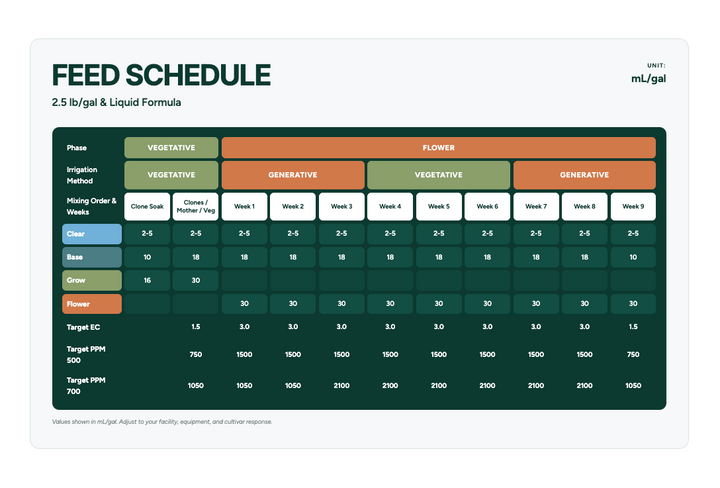
It depends on crop, stage and medium. HGV's published schedule targets an EC of 3.0 through flower, with lighter feed for clones and early veg. Start there, watch the plants and adjust.
Do hydroponic nutrients work in coco and rockwool?
Yes. Coco coir, stone wool and peat-based mixes are all soilless media that depend on a complete nutrient solution. HGV has been tested in each of them and in liquid hydroponic systems.