Bloom Nutrients: What to Feed in Flower, and When
When to switch from grow to bloom, how strong to feed through flower, and whether a bloom booster earns its place.
Bloom nutrients are fertilizers formulated for the flowering stage. They cut nitrogen back and raise phosphorus, potassium and sulfur, which is what a plant draws most heavily while it builds flowers. Switch from your grow formula to your bloom formula when flowering begins, and keep calcium and nitrogen coming from the base part all the way through.
What makes a nutrient a "bloom" nutrient?
The difference is the ratio. Vegetative growth is nitrogen-hungry because the plant is building leaves and stems. Once flowering starts, demand shifts toward phosphorus for energy transfer, potassium for moving water and sugars, and sulfur for proteins and aromatic compounds.
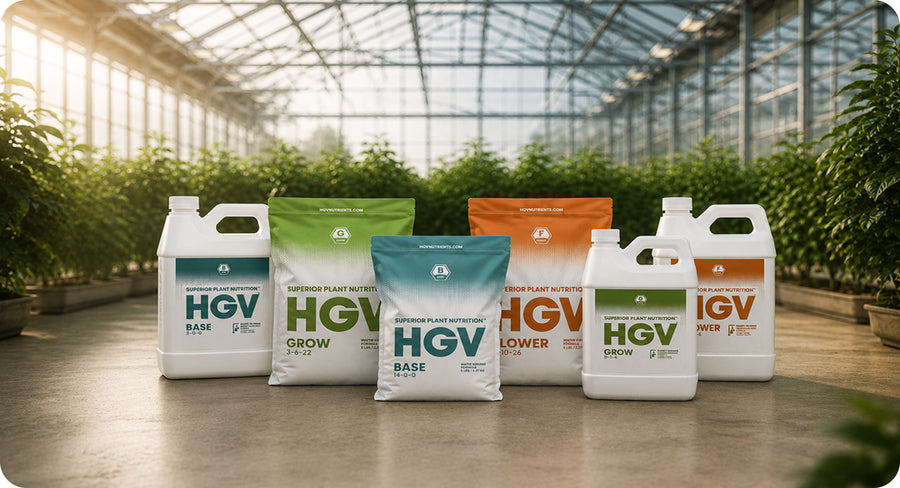
| HGV product | Analysis (N-P-K) | Used in | Role |
|---|---|---|---|
| Base | 14-0-0 | Veg and flower | Calcium and nitrogen for the whole cycle |
| Grow | 3-6-22 | Veg | Vegetative vigor and canopy development |
| Flower | 0-10-26 | Flower | Phosphorus, potassium and sulfur for the generative phase |
Notice that the bloom part carries no nitrogen at all. The plant still needs some nitrogen in flower, and it gets it, together with calcium, from Base. That is why a two-part program swaps only one product at the transition.
When do you switch from grow to bloom nutrients?
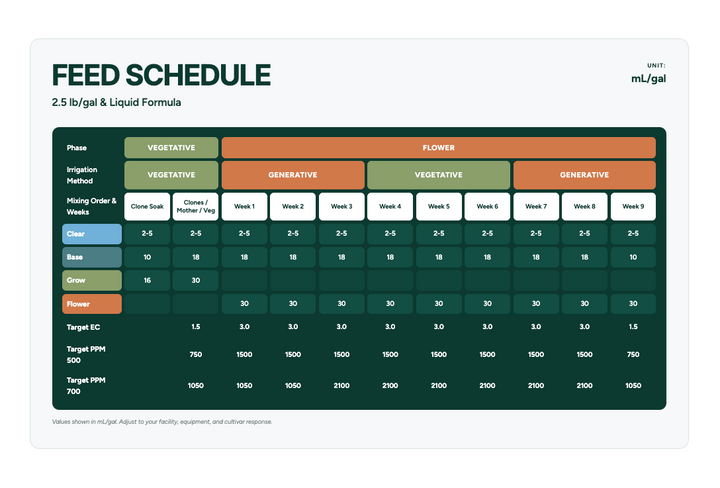
Switch when the plant enters flower. For photoperiod crops grown indoors, that is the day you change the light schedule. HGV's feed schedule moves from Base plus Grow to Base plus Flower at week one of flower and holds that pairing to harvest. There is no need to blend Grow and Flower through a transition period.
How much bloom nutrient should you feed?
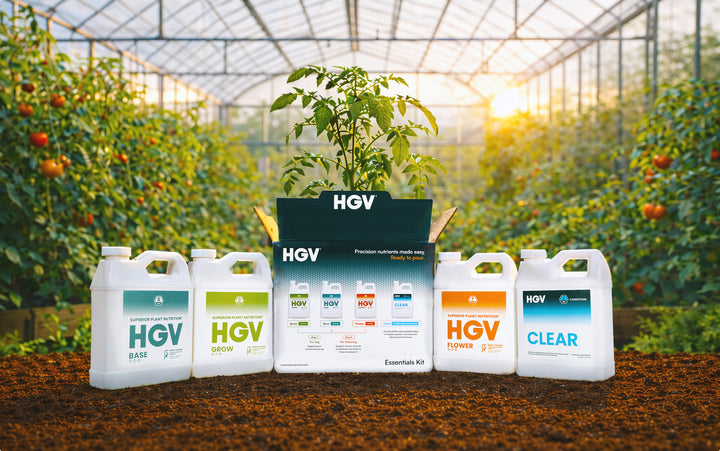
HGV's schedule targets an EC of 3.0 through flower. With the Liquid line or a 2.5 lb per gallon concentrate, that is 18 mL of Base and 30 mL of Flower per gallon. Measuring dry, it is 4.2 g of Base and 7.0 g of Flower per gallon. Treat 3.0 as a starting point and adjust for your medium, pot size, environment and genetics.
The schedule eases off in the final week before harvest. Follow the published numbers rather than cutting feed early. Maturation time is set by genetics, and a plant that runs out of nutrition before it finishes is a stressed plant, not a faster one.
Do you need a bloom booster?
A bloom booster is an additive, usually extra phosphorus and potassium, sold to stack on top of a base program. Whether it earns its place depends on what the base program already supplies. If your bloom formula is complete, more P and K does not mean more flower. It means a higher EC and a less balanced solution.
HGV's position after extensive additive testing is simple: unless an additive directly improves yield, potency or terpene production, the added cost may not be justified. Run a side-by-side before committing a whole room to it. Many growers cut costs by removing products they could not measure a benefit from.
Does sulfur matter in flower?
Yes, and it is often overlooked on labels that only advertise N-P-K. HGV formulas are rich in sulfates, which have been shown to support terpene expression. Potency is driven mainly by plant health and genetics, and what happens after harvest matters too: drying and curing decide how much of that terpene content survives.
What are the common mistakes in flower?
- Too much nitrogen late. Staying on a veg formula into flower, or adding a nitrogen-bearing supplement, keeps the plant vegetative.
- Chasing deficiencies with additives. Check pH and root-zone EC before adding anything. Most "deficiencies" in flower are uptake problems.
- Reading purple as a nutrient problem. Purple color is usually genetic. A phosphorus deficiency, often tied to cold, can also cause purpling but looks different and comes with other symptoms.
Frequently asked questions
What NPK is best for the flowering stage?
Low nitrogen with elevated phosphorus and potassium. HGV's flowering program pairs Base (14-0-0) with Flower (0-10-26), so nitrogen and calcium continue at a controlled level while phosphorus, potassium and sulfur lead.
Can I use bloom nutrients during veg?
You can, but growth will be slower. A bloom part does not carry the nitrogen a vegetative plant needs. Use a grow formula in veg and switch at the start of flower.
Does more phosphorus mean bigger flowers?
No. Plants use phosphorus in modest amounts, and excess does not convert to yield. It raises EC and can interfere with the uptake of micronutrients such as zinc and iron. Balance matters more than any single element.
When should I stop feeding bloom nutrients?
Follow your feed schedule to harvest. HGV's schedule reduces strength in the final week instead of stopping abruptly. The plant's maturation timeline is set by genetics, not by withholding nutrition.
Are bloom nutrients different for coco, rockwool and hydro?
The formula is the same. What changes is irrigation frequency and how closely you watch runoff. HGV recommends starting at EC 3.0 across media and adjusting to what the plants show you.