



Get the printable resource sheet
Keep a copy at the mixing station or send it to your team.

System Support
Grower-facing reference for water testing, feeding troubleshooting, environmental targets, and facility maintenance, the working manual behind every HGV system.
Water Testing & pH
Recommendations
The Importance Of Water Testing
Understanding your source water is the foundation of every successful feed program. A lab analysis tells you what is already in solution before a single nutrient is added.
Obtaining a water sample is a great practice for many reasons:
- Helps you determine what type of filtration (if any) is required. Dependent on where you're located, sometimes no filtration is needed.
- Helps you to understand what elements are already in solution, which can change the composition of the nutrient formula being injected into the garden.
- Municipalities may change chemicals used to treat water, which can alter the outcome of your pH and nutrient solution. Testing every 6 months can help determine if any changes were made, and what direction is best to move forward.
pH Up Recommendations
PH UP, WHAT IS IT?
A product that increases the pH level of water to make it more alkaline.
WHEN TO USE IT?
- When nutrient solution pH is below target pH and having the need to increase solution pH.
- Typically used when using RO or heavily filtered water.
BEST PRACTICES & WHY
- Always best to fully dilute pH up prior to injection or mixing.
- Given the caustic nature of pH Up, it has a high chance of reacting with other elements in solution (mainly calcium and sulfates).
- Diluting prior to use ensures there's a homogenous mix reducing the risk of "fallout".
DIFFERENT TYPES
- Potassium Hydroxide
- Potassium Carbonate
- Potassium Silicate
(see below for dilution recommendations)
pH Up Dilution Recommendations
Potassium Hydroxide 17% (HGV pH+)
DILUTION RATE
50:1
USAGE (AFTER DILUTION)
15–35 ml/gal
3% K₂O (HGV Level)
DILUTION RATE
1:1
USAGE (AFTER DILUTION)
15–35 ml/gal
Potassium Carbonate
DILUTION RATE
0.1–0.25 lb/gal
USAGE RATE
Dependent on starting pH, 5–20 ml/gal
pH Down Recommendations
PH DOWN, WHAT IS IT?
A product that lowers the pH level of water to make it more acidic.
WHEN TO USE IT?
- Use when pH is above target pH of solution.
- Typically used when utilizing well or tap water.
BEST PRACTICES & WHY
- Always best to obtain a water analysis to see what could be reacting with the water.
- This can determine what acid would be of best use for a pH down.
- In some cases, diluting your pH down can minimize reactions.
DIFFERENT TYPES
- Phosphoric Acid
- Nitric Acid
- Sulfuric Acid

Built for serious yields,
backed by real system support.
Troubleshooting & Systems
Support Guide
Common questions from the field, organized by concern. Tap a topic to expand it.
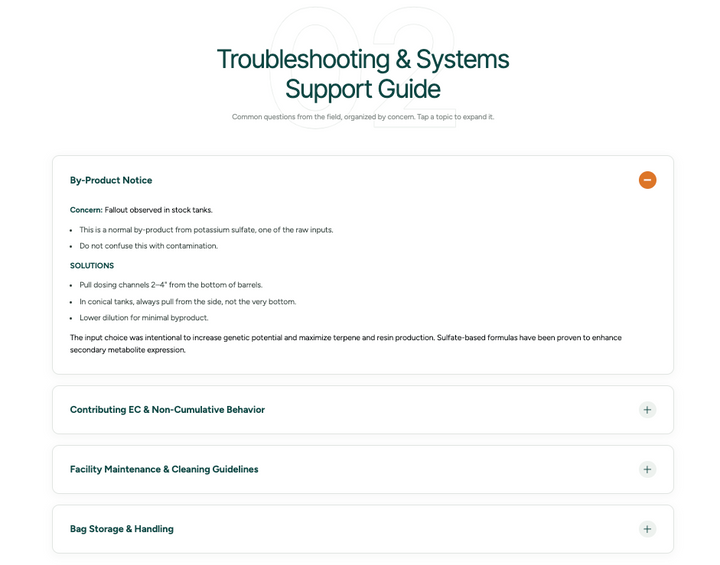
By-Product Notice
Concern: Fallout observed in stock tanks.
- This is a normal by-product from potassium sulfate, one of the raw inputs.
- Do not confuse this with contamination.
SOLUTIONS
- Pull dosing channels 2–4" from the bottom of barrels.
- In conical tanks, always pull from the side, not the very bottom.
- Lower dilution for minimal byproduct.
The input choice was intentional to increase genetic potential and maximize terpene and resin production. Sulfate-based formulas have been proven to enhance secondary metabolite expression.
Contributing EC & Non-Cumulative Behavior
Concern: When using two separate mixes with EC values of 1.2 and 1.8, the final EC is not reaching the expected 3.0.
Explanation: Nutrients are considered non-cumulative, meaning that the individual EC values of separate solutions do not add linearly.
- 1.2 EC + 1.8 EC ≠ 3.0 EC
- In reality, this combination will likely result in a final EC of ~2.5 to 2.7
Why?
- Individual EC values do not simply add up.
- Ionic interactions, dilution effects, and measurement variability cause the final EC to be lower than the sum of individual parts.
To achieve a 3.0 EC when mixing separately you will need:
- HGV Base / Cal-Nit: 1.4 – 1.6 EC
- HGV Grow or Flower: 1.8 – 2.1 EC
- Together, these values will more reliably yield a total EC close to 3.0, assuming stable water quality.
Best Practice: Follow all recommended usage guidelines, conduct a nutrient analysis of the final solution, and contact your HGV rep for a review to ensure nutrient ratios and EC targets are accurate.
Facility Maintenance & Cleaning Guidelines
Batch Tanks:
- Clean every 7 - 14 days.
- With sterile fertilizers, cleaning frequency may be extended.
Stock Tanks:
- Clean after every 2 - 3 batches.
Fertigation Systems:
- Perform a full system cleaning once per month to maintain optimal performance.
- Once or twice monthly, verify each doser is accurately pulling the correct amount of input using doser-specific calibration methods.
Line Sets & Emitters:
- With proper maintenance, line sets and emitters should last 2+ years.
- Be aware of pH compatibility with emitter and line set materials.
- Use catch cups regularly to ensure consistent and uniform distribution.
Disc Filters:
- Clean once a month or once a cycle.
Room Turnover Protocol:
- Flower Rooms
- Conduct a thorough cleaning between every harvest
- Use appropriate disinfectants and sanitizers to eliminate molds, pathogens, and pests
- Clone / Mother / Veg Rooms
- Maintain a consistent and proactive IPM schedule.
- A clean and well-managed veg environment helps prevent downstream issues in flower.
Bag Storage & Handling
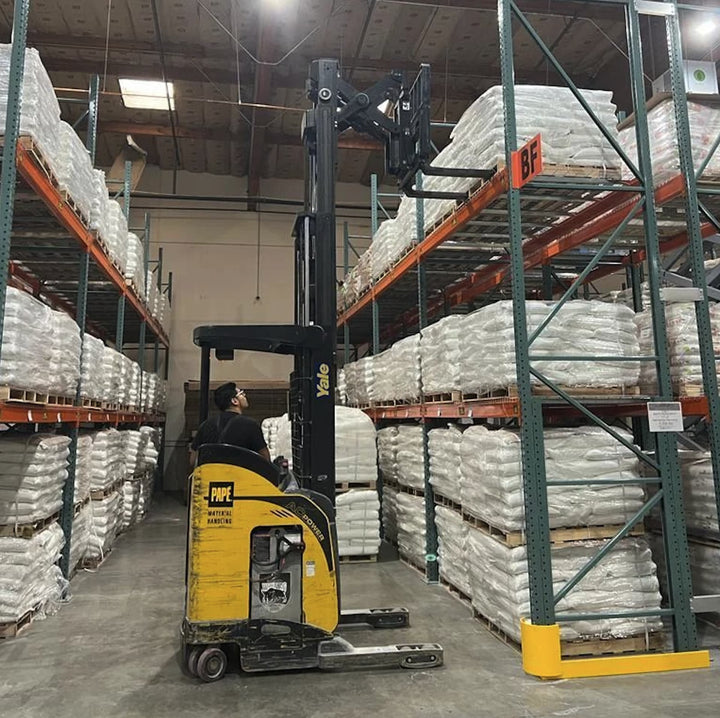
Storage Environment Check:
- Products should be stored in conditions no warmer than 75°F and no higher than 40% RH (Relative Humidity).
Solution:
- Increase order cadence to minimize the amount of time products sit before use.
Troubleshooting Clogging In
Irrigation Lines
Section 03, Diagnostic Checklist
How does your batch tank look?
Final solution clarity should match that of clean water, free of visible particles, cloudiness, or residue.
What type of water are you using?
- RO (Reverse Osmosis) Water: follow RO-specific steps (see below).
- Tap/Well Water: follow Tap/Well-specific steps (see below).
Are the ratios correct?
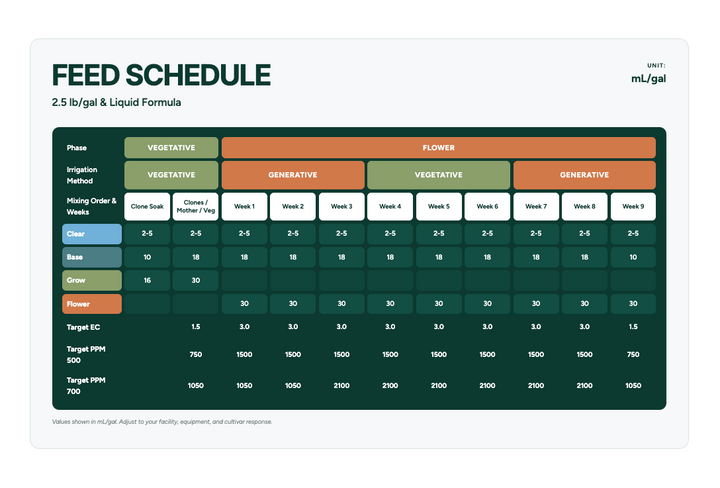
- Are you maintaining the 60/40 ratio between Base and Grow/Flower?
- For every 0.6 ml of base, it's 1 ml of Grow/Flower, assuming concentrations are the same.
DOSING CHANNELS
- Are your dosing channels pulling from 2–4" off the bottom of the barrel? If not, adjust immediately.
MIXING ORDER
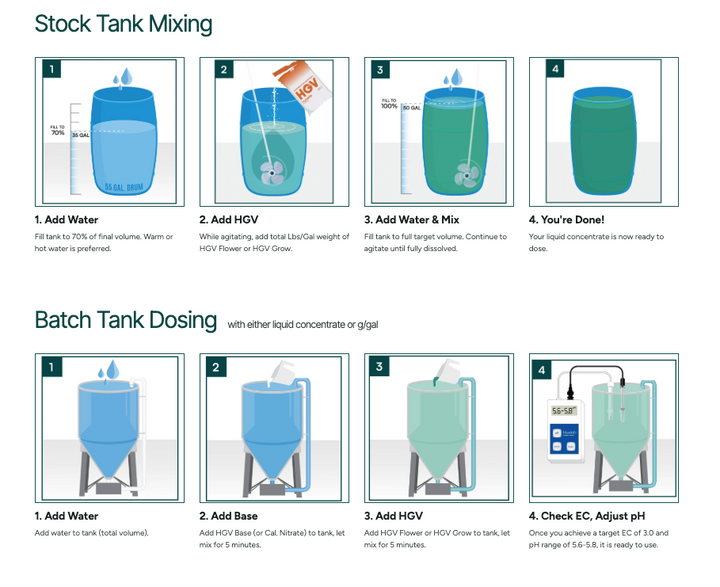
- Confirm you are following the official HGV mixing order.
PH PRODUCT USED
What are you using for pH adjustment? Confirm dilution rates:
- HGV pH+: 50:1 dilution (50 gallons water : 1 gallon HGV pH+).
- HGV Level: use straight from bottle or 1:1 dilution.
- pH+ 33% or higher: 100:1 dilution (100 gallons water : 1 gallon pH+).
- Potassium Carbonate/Bicarbonate: 0.1–0.2 lb/gal (0.1 ideal).
- HGV pH-: use straight from bottle or 1:1 dilution.
TYPE OF PRECIPITATE OBSERVED
Glass-like shards or pasty material? Contact rep for further assistance.
Plant Health &
Environmentals
KEY TAKEAWAY
Environment should always be the #1 priority in any cultivation space. In our experience, 9 out of 10 plant health issues are directly tied to environmental inconsistency, not nutrition. The root cause of most problems stems not from what is fed, but from how consistently conditions are maintained.
It's not just about what set-points you've programmed, but where the room actually sits throughout the day. Fluctuations in temperature, humidity, and VPD are among the leading causes of:
- Plant stress
- Nutrient uptake issues
- Pathogen susceptibility
- Inconsistent growth or terpene expression
Follow the environmental charts below for guidance on optimal ranges and transition timing. These charts provide best-practice targets for:
- Day/night differentials
- Vegetative vs. generative steering
- Humidity-to-temperature balance
LEDs
| Stage | Daytime Temp | Night Temp | Daytime Humidity | Night Humidity | PPFD | CO2 |
|---|---|---|---|---|---|---|
| Clones | 82-84° | 82-84° | 70-75% | 70-75% | 150-200 | 400-600 |
| Early Veg | 82-84° | 82-84° | 70-75% | 70-75% | 350-400 | 600-1200 |
| Mid Veg | 82-84° | 82-84° | 70-75% | 70-75% | 450-500 | 600-1200 |
| Late Veg | 82-84° | 82-84° | 70-75% | 70-75% | 550-600 | 600-1200 |
| Day 1 | 82-84° | 82-84° | 70-75% | 70-75% | 600 | 600-1200 |
| Day 2 | 82-84° | 82-84° | 70-75% | 70-75% | 650 | 600-1200 |
| Day 3 | 82-84° | 82-84° | 70-75% | 70-75% | 700 | 600-1200 |
| Day 4 | 82-84° | 82-84° | 70-75% | 70-75% | 750 | 600-1200 |
| Day 5 | 82-84° | 82-84° | 70-75% | 70-75% | 750 | 600-1200 |
| Day 6 | 82-84° | 82-84° | 70-75% | 70-75% | 750 | 600-1200 |
| Day 7 | 82-84° | 82-84° | 70-75% | 70-75% | 750 | 600-1200 |
| Week 2 | 80° | 80° | 70-75% | 70-75% | 800-1300 | 750-1500 |
| Week 3 | 78° | 78° | 70% | 65% | 800-1300 | 750-1500 |
| Week 4 | 78° | 76° | 65% | 60% | 800-1300 | 750-1500 |
| Week 5 | 76° | 74° | 65% | 60% | 800-1300 | 750-1500 |
| Week 6 | 76° | 72° | 60% | 55% | 800-1300 | 750-1500 |
| Week 7 | 74° | 70° | 55% | 50% | 800-1300 | 750-1500 |
| Week 8 | 72-74° | 68-70° | 55% | 50% | 800 | 750-850 |
| Week 9 | 70-72° | 66-68° | 50% | 45% | 700 | 600-700 |
Disclaimer, these are general guidelines and should be adjusted based on your facility's capabilities, equipment performance, and cultivar response. Work with your HGV support rep to dial in precision.
HIDs
| Stage | Daytime Temp | Night Temp | Daytime Humidity | Night Humidity | PPFD | CO2 |
|---|---|---|---|---|---|---|
| Clones | 80° | 80° | 75-80% | 75-80% | 150-200 | 400-600 |
| Early Veg | 80° | 80° | 65-70% | 65-70% | 350-400 | 600-1200 |
| Mid Veg | 80° | 80° | 65-70% | 65-70% | 450-500 | 600-1200 |
| Late Veg | 80° | 80° | 65-70% | 65-70% | 550-600 | 600-1200 |
| Day 1 | 80° | 80° | 65-70% | 65-70% | 600 | 600-1200 |
| Day 2 | 80° | 80° | 65-70% | 65-70% | 650 | 600-1200 |
| Day 3 | 80° | 80° | 65-70% | 65-70% | 700 | 600-1200 |
| Day 4 | 80° | 80° | 65-70% | 65-70% | 750 | 600-1200 |
| Day 5 | 80° | 80° | 65-70% | 65-70% | 750 | 600-1200 |
| Day 6 | 80° | 80° | 65-70% | 65-70% | 750 | 600-1200 |
| Day 7 | 80° | 80° | 65-70% | 65-70% | 750 | 600-1200 |
| Week 2 | 80° | 80° | 65% | 65% | 800-1100 | 750-1500 |
| Week 3 | 78° | 78° | 65% | 65% | 800-1100 | 750-1500 |
| Week 4 | 78° | 76° | 60% | 60% | 800-1100 | 750-1500 |
| Week 5 | 76° | 72° | 60% | 55% | 800-1100 | 750-1500 |
| Week 6 | 74° | 70° | 60% | 55% | 800-1100 | 750-1500 |
| Week 7 | 74° | 70° | 55% | 50% | 800-1100 | 750-1500 |
| Week 8 | 70° | 66° | 50% | 45% | 800 | 750-850 |
| Week 9 | 68-70° | 65-67° | 45-50% | 40-45% | 700 | 600-700 |
Disclaimer, these are general guidelines and should be adjusted based on your facility's capabilities, equipment performance, and cultivar response. Work with your HGV support rep to dial in precision.
Line Cleaning SOP
Prepare Cleaning Solution
- Dilute Sulfuric Acid (or Remix Chem Max Acid Clean) to a 0.6% concentration (usually around 50–60 mL/Gal at 30–40% concentrated sulfuric acid).

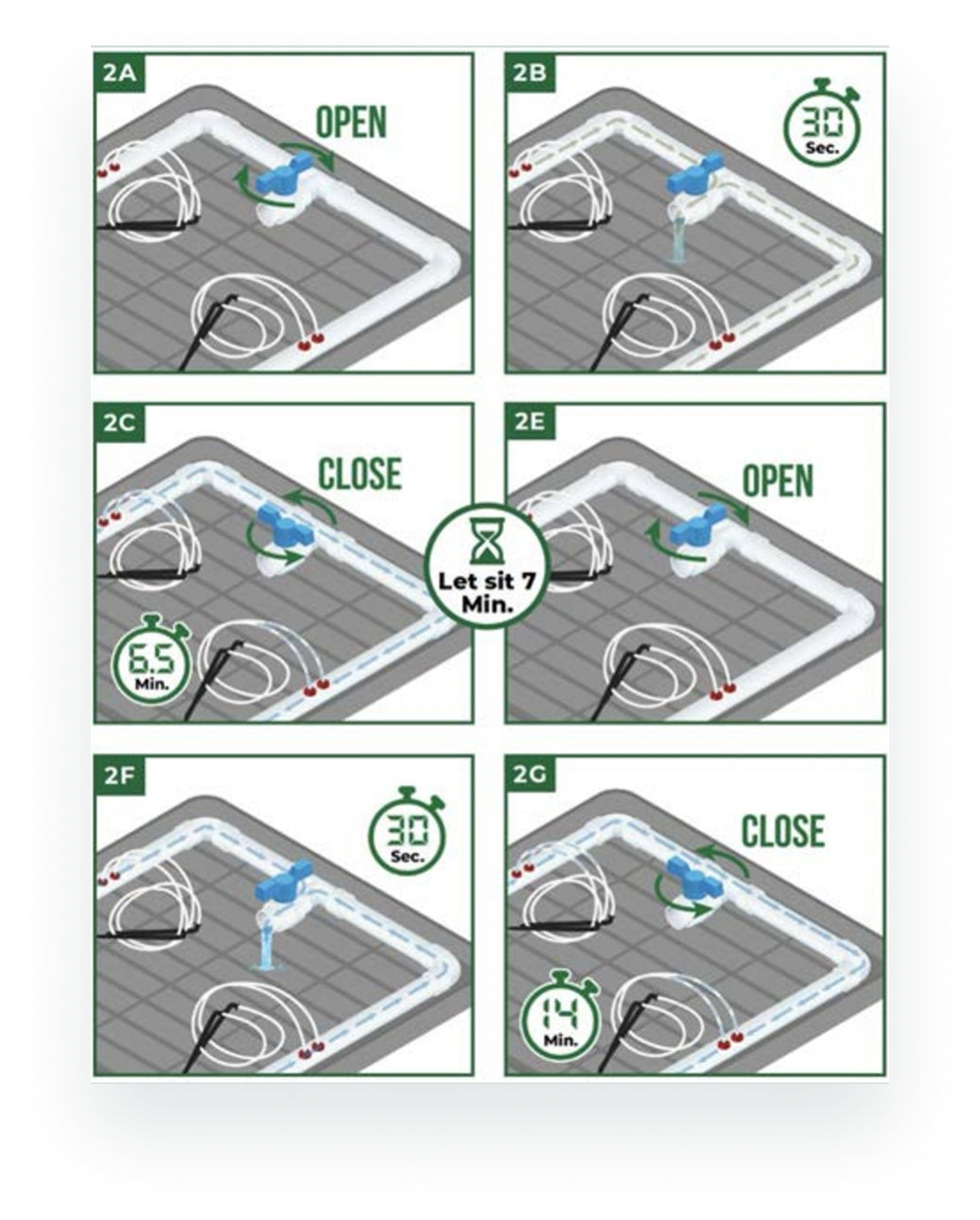
Line Cleaning Procedure
- Open flush valves at end of irrigation.
- Run irrigation with flush valves open for 30 seconds.
- Close flush valves and continue irrigation for 6.5 minutes.
- Let sit for 7 minutes.
- At 14 minutes total contact time (irrigating and resting combined) open flush valves once again.
- Run pure water for 30 seconds with flush valves open, then close.
- Run double the amount of pure water through irrigation than your sulfuric acid flush (10–14 minutes total irrigation flush).
Test & Finish
Test random whips throughout your room with pitcher tests to ensure correct mL/min.
- 0.32 gph = 18–21 mL/min per emitter
- 0.5 gph = 30–36 mL/min per emitter
Can't find what you need?
Your HGV rep can walk through mixing, dosing, or troubleshooting live, or point you to the right guide.