EC and PPM Explained: How Strong Should Your Feed Be?
What your meter is really measuring, the 500 and 700 scale conversion chart, and a formula for fixing a batch that lands off target.
EC, or electrical conductivity, measures the total strength of a nutrient solution. PPM is the same reading converted to parts per million. Meters use one of two conversion scales: multiply EC by 500 or by 700. An EC of 3.0 is 1,500 ppm on the 500 scale and 2,100 ppm on the 700 scale, which is why EC is the more reliable number to share.
What is EC?
Dissolved mineral salts carry an electric current. The more nutrient in the water, the more current it carries. An EC meter measures that conductivity, usually in millisiemens per centimeter (mS/cm). EC tells you how strong the feed is. It does not tell you what is in it. Two solutions with the same EC can have very different nutrient ratios.
What is the difference between EC and PPM?
No meter measures ppm directly. It measures EC and multiplies by a conversion factor. Different manufacturers chose different factors, so the same solution can read as two different ppm values.
| EC (mS/cm) | PPM, 500 scale | PPM, 700 scale |
|---|---|---|
| 1.0 | 500 | 700 |
| 1.5 | 750 | 1,050 |
| 2.0 | 1,000 | 1,400 |
| 2.5 | 1,250 | 1,750 |
| 3.0 | 1,500 | 2,100 |
| 3.5 | 1,750 | 2,450 |
| 4.0 | 2,000 | 2,800 |
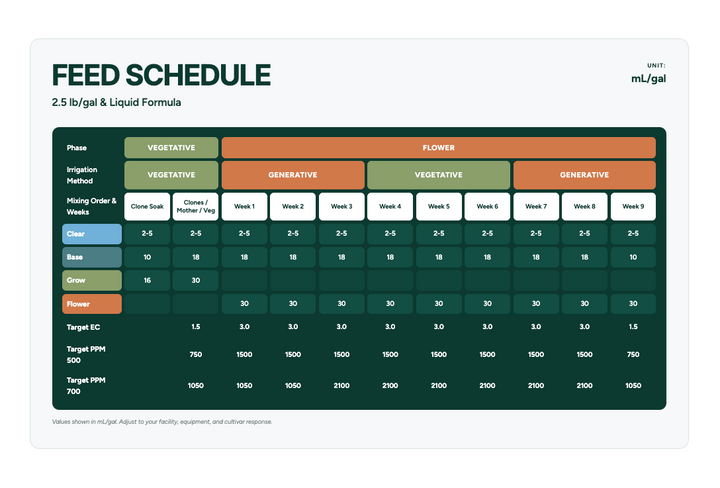
If someone tells you to feed at "1,500 ppm," you need to know their scale. If they tell you EC 3.0, there is nothing to translate. HGV's feed schedule lists the target EC along with both ppm scales for that reason.
How strong should your nutrient solution be?
HGV mixes to a target EC of 3.0 and a pH of 5.6 to 5.8. The published schedule runs clones, mothers and early veg lighter, at EC 1.5, holds 3.0 through flower and eases off in the final week. Starting at 3.0 is generally a safe approach across media and light types. From there, adjust for pot size, environment and genetics.
These are HGV's rates to reach each EC:
| Target EC | Dry: Base / Grow or Flower (g per gal) | Liquid or 2.5 lb/gal concentrate: Base / Grow or Flower (mL per gal) |
|---|---|---|
| 1.5 | 2.1 / 3.5 | 10 / 16 |
| 2.0 | 2.8 / 4.7 | 12 / 19 |
| 2.5 | 3.5 / 5.8 | 16 / 26 |
| 3.0 | 4.2 / 7.0 | 18 / 30 |
| 3.5 | 4.9 / 8.2 | 22 / 36 |
Does your source water count toward EC?
Yes. Tap and well water contain dissolved minerals that register on the meter before you add anything. Measure your source water first. Reverse osmosis water reads close to zero. Hard water can read 0.3 to 0.8 or more. Knowing your starting point, and what is actually in it, is the reason HGV recommends a water analysis before designing or retrofitting a facility.
What if your reading does not match the target?
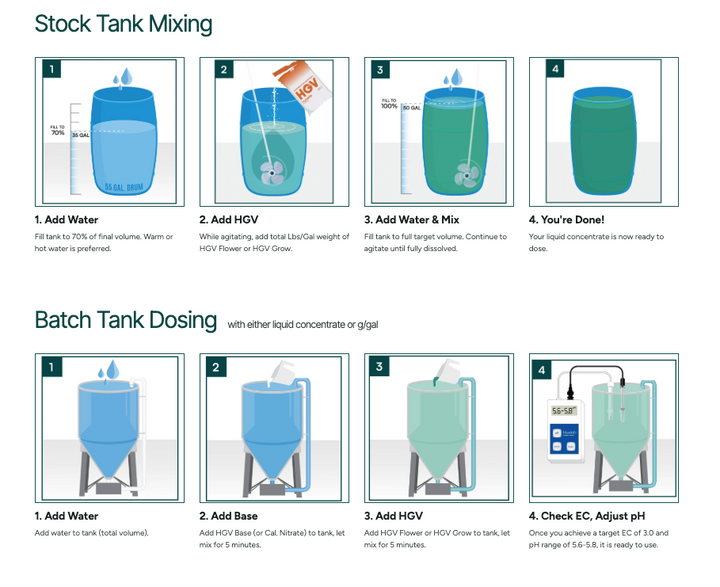
Use the adjustment formula from HGV's mixing guide:
- Divide the EC you measured by your target EC.
- Divide your current rate by that result.
Example: you mixed for 3.0 and read 2.5. 2.5 divided by 3.0 is 0.833. A Base rate of 15 mL per gallon divided by 0.833 becomes 18 mL. A Grow or Flower rate of 25 mL becomes 30 mL. Mix at the new rates and the batch will land on target.
What does runoff EC tell you?
Input EC is what you feed. Runoff EC is what is left after the root zone has had its turn. Comparing the two shows whether salts are building up or being used.
- Runoff near input: balanced.
- Runoff well above input: salts are accumulating. Increase runoff.
- Runoff well below input: the crop is hungry. Consider raising the feed.
How do you get an accurate reading?
- Calibrate the meter regularly with fresh calibration solution.
- Use a meter with automatic temperature compensation. Conductivity rises with temperature.
- Measure after everything is fully dissolved.
- Verify at the point of delivery, not only in the mixing tank. A difference between the two is information about your injectors or lines.
Frequently asked questions
Is EC or PPM better?
EC. It is the actual measurement, and it means the same thing on every meter. PPM depends on which conversion scale the meter uses.
How do you convert EC to PPM?
Multiply EC in mS/cm by 500 or by 700, depending on your meter's scale. EC 2.0 is 1,000 ppm on the 500 scale and 1,400 ppm on the 700 scale.
What is TDS?
Total dissolved solids. A TDS meter is an EC meter that displays its reading in ppm.
What EC is too high?
It depends on the crop, stage and medium. Signs that the feed is too strong for your conditions include brown leaf tips and runoff EC that keeps climbing above input.
Does pH affect EC?
Not directly, but pH adjusters are salts and add a small amount of EC. Reach your target EC first, then adjust pH.