NPK Explained: How to Read a Fertilizer Label
What the three numbers mean, why phosphorus and potassium are written as oxides, and how to turn a label into ppm in your tank.
NPK is the three-number code on every fertilizer label. It gives the percent by weight of nitrogen (N), available phosphate (P2O5) and soluble potash (K2O), always in that order. A product labeled 3-6-22 contains 3 percent nitrogen, 6 percent phosphate and 22 percent potash.
What do the three numbers mean?
| Position | Stands for | Expressed on the label as | What it does in the plant |
|---|---|---|---|
| First | Nitrogen | Total nitrogen (N) | Leaf and stem growth, chlorophyll, amino acids |
| Second | Phosphorus | Available phosphate (P2O5) | Energy transfer, roots, flower development |
| Third | Potassium | Soluble potash (K2O) | Water regulation, sugar transport, flower density |
Why are phosphorus and potassium listed as oxides?
It is a labeling convention with a long history, and it is required by fertilizer regulations in the United States. Nitrogen is reported as the element. Phosphorus and potassium are reported as the oxides P2O5 and K2O. The product does not necessarily contain those compounds. They are simply the units the guarantee is written in.
This matters when you read any label. A pH Down with a guaranteed analysis of 20% P2O5, or a pH Up guaranteed at 17% K2O, is stating its phosphorus or potassium content in the standard units, exactly as a bag of fertilizer does.
To convert to the actual element:
- Elemental phosphorus = P2O5 × 0.436
- Elemental potassium = K2O × 0.83
How do you read a guaranteed analysis?
The guaranteed analysis is the legally binding part of the label. Below the NPK line it lists every other nutrient the manufacturer guarantees, such as calcium, magnesium, sulfur and micronutrients, each as a minimum percent by weight. It also states what the nutrients are derived from. If an element is not in the guaranteed analysis, do not assume it is in the bag.
What do HGV's NPK numbers look like?
| Product | N-P-K | Stage |
|---|---|---|
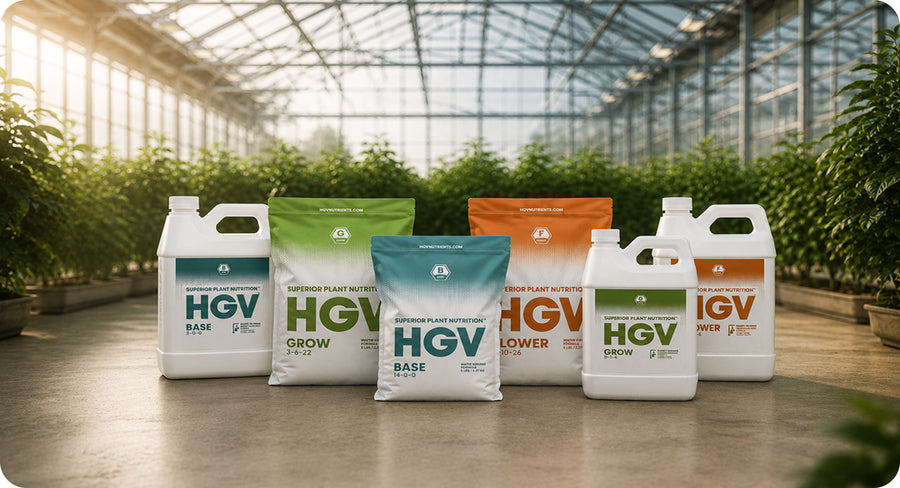
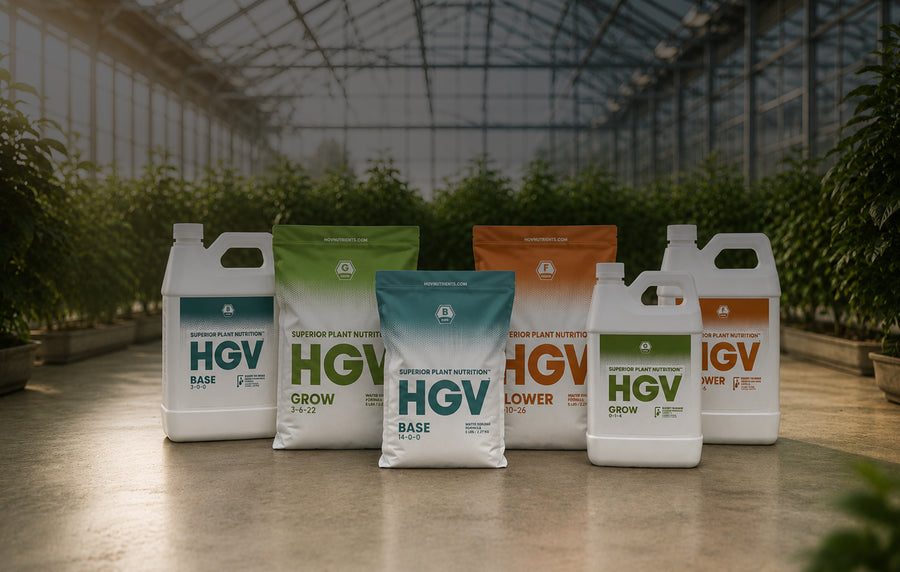
| HGV Dry Base | 14-0-0 | Entire cycle. Calcium and nitrogen |
| HGV Dry Grow | 3-6-22 | Veg |
| HGV Dry Flower | 0-10-26 | Flower |
Because HGV is a two-part program, no single bag tells the whole story. The plant receives the combination of Base and Grow, or Base and Flower.
How do you turn NPK into PPM?
The label gives percentages. What the plant experiences is concentration in the water, measured in parts per million. To calculate it:
- Multiply grams per gallon by the percentage on the label.
- For phosphorus and potassium, multiply by 0.436 or 0.83 to convert from the oxide.
- Multiply by 1,000 to get milligrams, then divide by 3.785 liters per gallon.
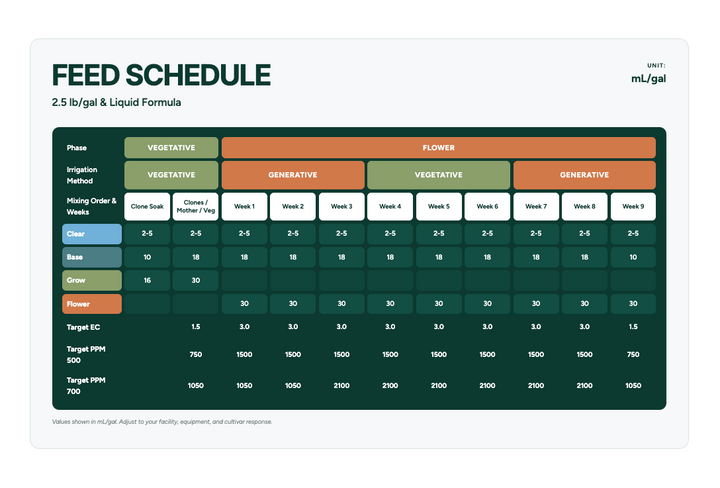
Worked example: HGV's flowering program at EC 3.0 uses 4.2 g of Base (14-0-0) and 7.0 g of Flower (0-10-26) per gallon.
| Element | Calculation | Result |
|---|---|---|
| Nitrogen | 4.2 g × 14% = 0.588 g, ÷ 3.785 L | About 155 ppm N |
| Phosphorus | 7.0 g × 10% × 0.436 = 0.305 g, ÷ 3.785 L | About 81 ppm P |
| Potassium | 7.0 g × 26% × 0.83 = 1.511 g, ÷ 3.785 L | About 399 ppm K |
Run the same math for the veg program, 4.2 g of Base and 7.0 g of Grow (3-6-22), and you get roughly 211 ppm N, 48 ppm P and 338 ppm K. These figures are calculated from the label guarantees. They show clearly how the program moves nitrogen down and phosphorus and potassium up when you switch to flower.
Is a higher NPK number better?
No. Higher numbers mean a more concentrated product, so you use less of it. They say nothing about whether the ratio suits your crop. A 20-20-20 is not twice as good as a 10-10-10. It is the same ratio at twice the strength. What matters is the ratio at each growth stage and the concentration you deliver in the water.
Frequently asked questions
What does NPK stand for?
Nitrogen, phosphorus and potassium, using their chemical symbols N, P and K. On a label the numbers are the percent by weight of nitrogen, phosphate (P2O5) and potash (K2O).
What is a good NPK ratio for veg and for flower?
Veg favors more nitrogen relative to phosphorus. Flower favors little nitrogen with higher phosphorus and potassium. In the HGV program that shift is the move from Grow (3-6-22) to Flower (0-10-26), with Base (14-0-0) supplying calcium and nitrogen throughout.
Why does one part of a two-part nutrient show zeros?
Each part is only half of the recipe. A calcium and nitrogen part will show zeros for P and K, and a bloom part may show zero for N. The plant gets the sum of both.
Is K2O the same thing as potassium?
No. K2O, or potash, is the unit potassium is reported in. It is about 83 percent potassium by weight. A label guaranteeing 3% K2O contains about 2.5 percent elemental potassium.
Do liquid nutrients have lower NPK numbers than dry?
Yes, because they are diluted with water. The numbers are percent by weight of the whole product. A liquid with lower numbers can deliver identical nutrition once you account for the higher dose.